Body Build
I'd reached a point in my own wellness journey where I wanted to track aspects of my health — what I was eating, how much water I was drinking, whether I was moving — without becoming obsessive about my weight. Conversations with friends made it clear I wasn't alone. We were all working toward health goals and wanted to see our progress, but every app we tried pushed us into a mindset we were actively trying to leave behind. Body Build is for the people in between: health-conscious but not chasing optimization.
Client
Personal project
Services
UX Research, UI & UX Design, Prototyping, Product Build (with Claude Code)
Industries
Healthcare
Date
2 weeks (May 2026)
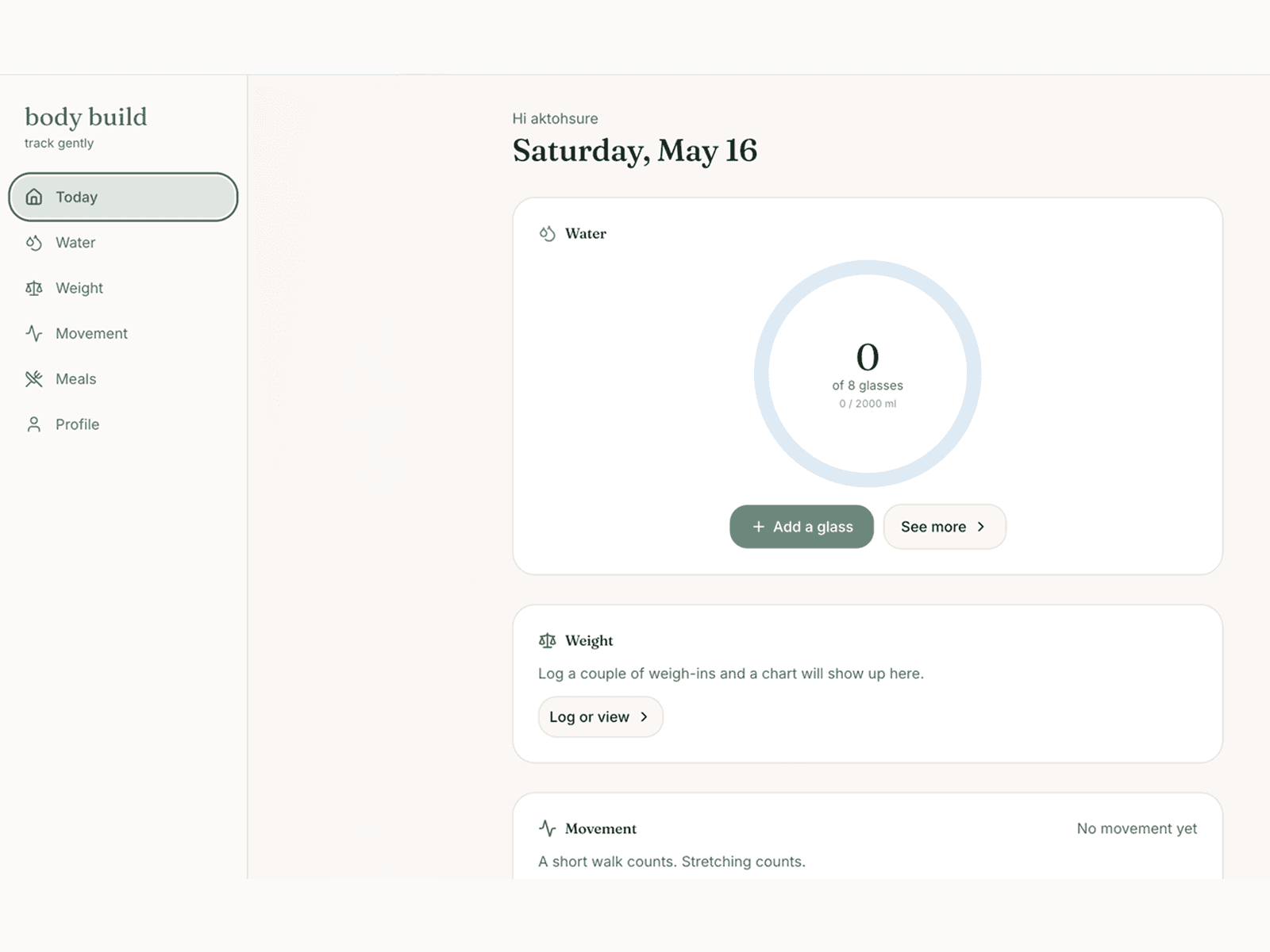
Most wellness apps are built for people who want to optimize. Body Build is built for people who want to be aware. It's a simple web app that lets users track meals, water, and movement without calorie counts, streaks, or social pressure — and suggests meals based on their dietary needs. After ongoing conversations with friends who shared the same frustration with existing tools, I designed and shipped a live MVP that prioritizes clarity and self-pacing over optimization.
The Problem The existing wellness app landscape has a personality. Calorie counting is the dominant model. Streaks and social comparison drive engagement. The default assumption is that more data is better, more tracking is better, and more feedback is better. For my target user — people who want awareness, not optimization — this is exhausting. The friction points come up again and again in conversation: Calorie counting feels punitive. It reframes eating as math and turns every meal into a calculation. Social and streak pressure backfires. For users who aren't already in a consistent routine, missing a day reads as failure rather than a normal week. Too much to track. Apps designed for fitness enthusiasts assume users want to log macros, sleep stages, heart rate variability, and a dozen other metrics. For someone just trying to build awareness, this is overwhelming on day one. The gap: a wellness app for people who want to track less, not more.

The Solution Body Build's MVP is built around four core areas: 1. Onboarding that sets the user's baseline A short onboarding flow captures goals, current state, and dietary restrictions. This becomes the foundation for personalized meal suggestions and keeps the rest of the app distraction-free — no re-asking, no setup-as-you-go. 2. The daily loop: log, log, log, summary The core use loop is intentionally minimal. Users log water whenever they drink, log meals when they eat, log movement when they move, and check a today's summary view. No streaks. No comparisons. No nudges to do more. 3. Meal Ideas Based on the dietary restrictions a user sets during onboarding, AI recommends meals from a curated library. This addresses the most common request that came up in feedback: people wanted help with what to eat, not just a place to record it. 4. Progress, on the user's terms Progress is shown as a simple summary — not a streak, not a leaderboard, not a heatmap of how often you've shown up. Just what you tracked, when.
Process & Key Decisions Designed wireframes, then built with AI assistance. I designed Body Build end-to-end and worked with Claude Code to ship a live product using Vercel, GitHub, Supabase, and Resend — the same stack I used for Ẹ̀gbẹ́. Building both helped me move from prototype to working product inside the 2-week window. Replacing the GitHub-style tracker. My first version had a contribution-graph-style progress tracker — small squares that filled in as users logged activity, modeled after GitHub's commit calendar. I liked the visual density, but it didn't fit the audience. Users I designed for weren't logging often enough for the squares to read as progress; instead, the mostly-empty grid read as failure. The visual that's motivating for daily exercisers is demotivating for the casually health-conscious. I replaced it with a simpler today's-summary view focused on what the user had done, not what they hadn't. Adding the Meal Ideas section. The most consistent piece of feedback in early conversations was that tracking meals was easy — but deciding what to eat was the harder problem. I added Meal Ideas as a dedicated section, with recommendations driven by the dietary restrictions captured during onboarding. Adding movement tracking. I initially scoped Body Build to meals and water. Conversations with my target users surfaced that movement was a third pillar they wanted to track — not workouts logged in detail, but a lightweight "did I move today?" check-in. Adding it without making it feel like a fitness app required keeping the input simple.


Outcome Live MVP shipped in 2 weeks Three significant changes driven by user input: GitHub tracker removed, Meal Ideas added, movement tracking added A product that intentionally trades engagement metrics (streaks, comparisons) for fit with its specific audience
What's Next User testing with the live MVP to validate that the non-intimidating framing holds up beyond conversations Expanding the meal library and exploring whether users want to save favorites Considering opt-in reminders without re-introducing the streak/pressure mechanics the product is designed to avoid
Reflection
The hardest decision in Body Build wasn't what to add — it was what to leave out. Streaks, social features, calorie math, and dense progress visualizations are all "better engagement" by industry default, but each one would have undermined the product's reason to exist. Designing for a user who wants less meant constantly defending simplicity against the instinct to add more.